Date: 28 September 2026
The changes provided immediate relief to long dated gilt prices but exposed the fragility of the monetary system and tested the credulity of the BoE’s independence. We delve into the key details and what this all means for DB pension schemes below:
The quantitative easing stockpile
The Bank of England holds c£488bn of QE-era gilts. This equates to roughly one in every six gilts in issuance. What the BoE does with those gilts has a material impact on the price of gilts in the wider market. Pension schemes are usually interested in this because they are significant investors. Institutional investors including pension schemes and insurers hold roughly one in every five of the gilts. They are also interested because they use gilt yields to value their liabilities.
The Bank of England has, until now, been reducing the stockpile of gilts by allowing shorter dated gilts to mature. And also by selling longer dated gilts into the market (in other words QT has been operating). As gilt yields (especially longer dated ones) have risen it has increasingly shone a spotlight on whether they should be actively selling gilts into a market where prices have fallen (and yields have risen).
On 17 September the Bank of England confirmed that they were planning on making changes to the APF, changing the course of QT. Overall, the impact of the changes is to shift the balance of government debt to shorter maturities. This is a playbook being followed in the US as well, where we have recently seen Scott Bessent grabbing the headlines for ‘buy-backs’ of longer dated Treasuries. High borrowing costs are far from ideal for heavily indebted countries like the US and UK, and the move to shorter dated borrowing is a reflection of the fiscal constraints they are under.
Let’s look at the announced changes:
Proposed changes
Firstly, there is no proposed change to the gilts maturing before 2035, these are expected to run off with £222bn due to mature naturally over the next c8 years.
2035–2049 maturities (£146bn)
The proposal is to sell these at a consistent rate of c£20bn/year, which is a similar pace to the past year. This will result in these ‘medium’ maturity gilts being fully sold down around the same time as the shorter maturities have run-off (i.e. in c8 years). Also within the proposal, and yet to be confirmed by all parties, is a proposal to sell the gilts directly to the government rather than sell these into the market.
Post 2049 maturities (£120bn)
These are to be retained permanently, repurposed to "back" the Bank's banknote issue. The APF holds closer to one in every three of these longest dated gilts and there are fewer investors operating in this sector. As a result, removing these from the list of gilts to sell into the market has the biggest impact overall.
A distorted market
When QE was initiated and the BoE bought up swathes of gilts the market became distorted and gilt yields became lower than they would have been if left to natural market forces. Selling the gilts back into the market would have returned the supply to the level it would have been prior to intervention. Removing them leaves a permanent impact on the market, and leads to artificially lower yields.
The big problem is that higher yields choke the monetary system, as they lead to higher borrowing costs. Some might argue that a distorted market for government debt is better than a broken system, but we should recognise the distortion is there as it wouldn’t be unexpected if there were more actions taken that help to lower borrowing costs further down the line.
Shifting borrowing to the short end
£120bn of ultra-long gilts are now permanently off the market. If sold direct to the government, the remaining medium range of maturities will also not hit the open market at all.
Less long-end supply, all else equal, should mean better-supported long gilt prices and lower yields than the previous plan implied.
The intention is that the government will arrange for the c£20bn of annual gilts it purchases from the BoE to be cancelled. Since the government runs deficits, the £20bn will need to be raised by the DMO, and they will presumably do this at generally shorter maturities. This action maintains the overall debt level but shifts it to shorter maturities.
Lowering long-dated gilt yields
Bank staff estimate that the £20bn of gilt selling pressure had led to gilt yields being c20-30bps higher than they would have otherwise been.
Since the announcement we have seen long dated gilt yields fall by a similar margin, which seems to support that argument.
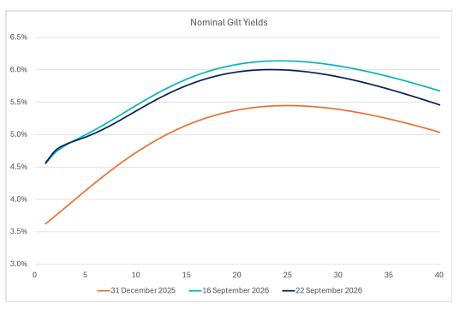
Figure 1: Nominal gilt yield curve before (16 September) and after (22 September) the BoE's APF announcement, with 31 December 2025 for context. Source: Bank of England
Falling gilt yields are good news for the market values of these gilts (admittedly this is following a pretty bad run for bond holders) but bad news for liability values. For well-hedged schemes the impact may be neutral, but it’s likely negative for under-hedged schemes.
Selling gilts to the government – a test of independence
The BoE argument is that the proposal to sell direct to the government is an efficient approach, allowing them to achieve a better overall sale price. That makes logical sense, however, it also (conveniently) allows the government to restructure their debt to the shorter (cheaper) end and it allows the BoE a way to fulfil its aim of getting the gilts off its books and allow it to more confidently claim its independence.
Pounds to back pounds?
The rationale for using ultra-long dated gilts (which are promises to pay pounds over a c50 year period) to back banknotes in issuance today is somewhat bizarre.
Pounds were once backed by a physical commodity (gold) but are now just a fiat currency. There is no physical backing to pounds, it is a trust-based system made up of digital records, notes and coins and the strength of the system is maintained by public trust in the system. Trust in the system is tested when the machinery gets distorted and the currency gets debased. We are living through an age where distortions and debasement are on the rise. The more that public trust is tested, the more the system’s fragility may be unveiled.
The choice of the least liquid gilts to back the banknotes might raise an eyebrow or two.
What this means for trustees
These changes reduce the supply pressure at the long end but do little to fix the underlying fiscal position, and the gilt market will stay under scrutiny. The BoE and the government have shown they are willing to step in when long-dated borrowing costs get too high, and it wouldn't be a surprise to see further measures aimed at bringing them down.
The plan to sell the medium-dated gilts to the government also still needs agreement from the DMO and the Treasury, with a final decision not expected until April 2027. If it doesn't go ahead, the BoE may go back to selling these gilts into the market and some of the recent fall in long-dated yields could reverse.
Gilt yields are being driven by policy decisions as much as by the market, and they can move sharply in either direction. With that in mind, we think trustees should:
- Make sure they know their current hedge ratio and understand why that level has been chosen. Liability hedging is an important tool to keep funding level volatility under control, but specific levels should be chosen with an eye to scheme specific circumstances.
- Understand what would happen to their funding position if yields were to rise or fall significantly from here. Testing funding levels, hedge ratios and collateral positions against a range of scenarios can be a helpful tool.
- Check that their LDI portfolio holds enough collateral to withstand a sharp rise in yields. The recent fall in yields will have helped, but September 2022 showed how quickly that can change.
- Review your growth portfolio's correlation to any unhedged liabilities. As market dynamics (and correlations between assets) change it makes sense to re-assess how resilient your portfolio is.
- Consider the impact of interest rate changes on the employer covenant, including whether higher or lower rates could strengthen or weaken the sponsoring employer's ability to support the scheme.
Please note: this communication is primarily aimed at Defined Benefit (DB) pension scheme clients. While much of the information and guidance may also be relevant to other client types, the specific actions required may differ.